This page is for informational and educational purposes only and does not constitute financial, investment, or tax advice. SATA is not a bank deposit, not FDIC insured, and carries risk of loss. Past performance is not indicative of future results. Always consult a qualified financial advisor before making investment decisions.
What Is SATA?
Strive's perpetual preferred stock. 13% yield, paid daily, powered by Bitcoin.
What Is SATA?
SATA is a stock you can buy on Nasdaq that pays roughly $0.05 per share every business day in cash — about $1.08 per month, or a 13% annual return on a $100 share. The price is designed to stay near $100 through a variable-rate mechanism — Strive adjusts the dividend rate to anchor it there.
It's issued by Strive, Inc. (Nasdaq: ASST), which holds about 15,009 Bitcoin on its balance sheet. The Bitcoin is what backs the whole thing.
Think of it like this: you give Strive $100. They buy Bitcoin with it. In exchange, they pay you about $13 per year in daily installments (~250 payments a year). The share price stays near $100 because Strive adjusts the interest rate to keep it there.
SATA is the second "digital credit" instrument to come to market, following Strategy's STRC. Same concept, different company, different scale.
How SATA Works
Jeff Walton — Strive's Chief Risk Officer — has been the most public voice explaining how SATA and instruments like it are structured. In a May 2026 debate with Coffeezilla, Walton laid out the core mechanics. The pieces are similar to STRC but with some key differences:
In the Coffeezilla debate, Walton pushed back directly on the Ponzi accusation by pointing to the reserves:
"A Ponzi scheme doesn't have reserves. This capital vehicle has reserves."
— Jeff Walton, Strive CRO, Coffeezilla Debate
Walton also explained the risk-tranche logic — why a preferred stock can sit on top of the same Bitcoin and offer a fundamentally different risk/return profile than the common equity:
"When we take the Bitcoin and we separate risk tranches... the seniority provides a lower risk position compared to the equity. We are carving off excess risk and excess return and that excess risk return goes to our common stock."
— Jeff Walton, Coffeezilla Debate
In plain English: SATA holders get the steady income. ASST common shareholders get the wild ride — and absorb the losses first if things go wrong.
SATA Dividend & Yield
SATA pays a daily dividend set as a percentage of its $100 par value, not the price you paid. This distinction matters.
The dividend rate has moved over SATA's shorter history:
| Date | Dividend Rate | Context |
|---|---|---|
| 2025 (Launch) | 12.0% | Launch rate |
| Early 2026 | 13.0% | Rate raised to support price near par |
| June 2026 | 13.0% | Switched from monthly to daily dividends |
Strive CEO Matthew Cole announced the daily dividend transition in May 2026, framing it as a historic milestone ahead of the June 16 launch:
"SATA will be the first listed security in the history of U.S. capital markets to pay cash dividends every single Business Day, beginning June 16, 2026, at a current annualized rate of 13.00%."
— Matthew Cole, Strive CEO, Yahoo Finance
Want to calculate your own monthly income? Use the SATA Dividend Calculator.
Where Does the Yield Come From?
Bitcoin doesn't generate cash flow. No interest, no dividends, no rent. So where does the 13% come from? Three sources — though notably, Strive has no operating cash flow to supplement them:
One critical difference from Strategy: Strive has no significant operating revenue. Strategy (formerly MicroStrategy) has a $320M/year software business that generates real cash flow. Strive is a pure Bitcoin treasury company — every dollar of dividend comes from the capital structure, not operations.
SATA Tax Treatment
Like STRC, SATA dividends are currently classified as return of capital (ROC) for US tax purposes. Here's what that means in practice:
For a high-bracket investor, the deferral effectively turns 13% into something closer to a 21% taxable-equivalent yield in real-world terms.
Capital Stack & Structure
Where a security sits in the capital stack determines who gets paid first when things go south. Strive's stack is notably simpler than Strategy's — there is no senior debt layer at all:
This is meaningfully different from Strategy's capital structure. Strategy has ~$6B in convertible bonds that sit above STRC preferred holders. Strive has zero debt. SATA holders are the most senior claim on Strive's balance sheet — there's nobody ahead of them in line.
That said, a simpler capital stack doesn't automatically mean lower risk. Strive's balance sheet is much smaller ($1.5B in BTC vs. Strategy's $87B+), and there's no operating cash flow to cushion drawdowns. The absence of debt is a genuine structural advantage, but the smaller asset base cuts the other way.
Who Is Buying SATA?
SATA's buyer base skews heavily retail, similar to STRC. The higher yield (13% vs. 11.5%) and daily dividend feature are the primary draws.
Risks of Investing in SATA
SATA carries all the structural risks of STRC plus several that are specific to Strive's smaller scale and newer track record.
Strive holds ~15,009 BTC (~$1.5B). Strategy holds 843,000+. A smaller treasury means less buffer in absolute terms. If Bitcoin crashes 80%, Strive's BTC treasury drops to ~$300M — barely enough to cover a few years of SATA obligations.
Strive has no meaningful operating business. Strategy generates ~$320M/year from its software division. Strive has nothing comparable — every dollar of dividend comes from the capital structure itself.
SATA trades at a fraction of STRC's daily volume. In a market panic, wider bid-ask spreads and thinner order books could make it harder to exit at a fair price. Liquidity risk amplifies every other risk.
No listed US security had ever paid daily dividends before SATA launched them in June 2026. The operational complexity of daily ex-dates, daily record dates, and daily settlements is uncharted territory. If brokerage systems or transfer agents struggle with the cadence, holders could experience delays or reconciliation issues.
SATA's 13% yield means Strive's cost of capital is 150 basis points higher than Strategy's. Bitcoin needs to appreciate at 13%+ annually for the math to work in a steady-state model. As Coffeezilla pointed out in the debate: "If Bitcoin doesn't appreciate 13%+ per year, you're losing money on the trade."
Strive is a younger, smaller company than Strategy. The leadership team, custody arrangements, and operational infrastructure are less battle-tested. Key-person risk around CEO Matthew Cole and CRO Jeff Walton is higher than at a $50B+ company.
Same structural risk as STRC. SATA launched at 12% and has already been raised to 13%. Each rate increase is a permanent cost added during price pressure. As Onramp CEO Michael Tanguma put it about these instruments: "A capital structure that survives volatility only by adding permanent obligations is a structure with a finite number of cycles in it."
If you hold Bitcoin through a 70% crash and it recovers, your Bitcoin is whole. SATA doesn't work that way. The same crash that Bitcoin recovers from can permanently impair SATA through forced BTC sales, dividend deferrals, or further rate ratchets — and these effects are amplified at Strive's smaller scale.
SATA vs STRC
There are currently two "digital credit" instruments on the market. SATA from Strive and STRC from Strategy. Same concept, some key differences:
| SATA | STRC | |
|---|---|---|
| Issuer | Strive (ASST) | Strategy (MSTR) |
| Yield | 13.0% | 11.5% |
| BTC Holdings | ~15,009 BTC (~$1.5B) | 843,000+ BTC (~$87B) |
| Cash Reserve | $138M (cash + STRC) | $2.25B |
| Debt | $0 — debt-free | ~$6B convertible bonds |
| Outstanding | ~$496M | ~$8.54B |
| Dividend Frequency | Daily | Monthly |
| Operating Business | None | $320M/yr software revenue |
| Liquidity | Lower | $250M-400M/day |
| Capital Stack | No senior debt above preferred | $6B convertible bonds above preferred |
The tradeoff is clear: SATA offers a higher yield and a cleaner (debt-free) balance sheet, but comes with significantly less scale, lower liquidity, no operating cash flow, and a shorter track record. The 150 bps premium compensates for these differences.
For a detailed side-by-side with calculators, see the STRC vs SATA comparison. Or see where to buy STRC if you're considering both.
SATA vs ASST
Same company, same Bitcoin on the balance sheet — but two completely different instruments. As Jeff Walton explained in the Coffeezilla debate, the logic is risk tranching: SATA gets the income, ASST gets the volatility.
| SATA | ASST | |
|---|---|---|
| Type | Preferred stock | Common stock |
| Purpose | Steady income | Bitcoin price exposure |
| Dividend | 13% annually, paid daily | None |
| Price behavior | Anchored near $100 | Highly volatile |
| Bitcoin upside | None (capped near par) | Full (leveraged beta) |
| Capital stack | Senior to common | Junior (last in line) |
| Risk profile | Lower — gets paid first | Higher — absorbs losses first |
Walton framed it succinctly: the seniority in the capital stack means SATA holders take a lower-risk position, while the excess risk and excess return flows to the common stock. If Bitcoin doubles, ASST holders capture the upside. If Bitcoin crashes, SATA holders have structural protection — they get paid before ASST holders get anything.
The Bull & Bear Debate
In May 2026, YouTuber Coffeezilla debated Jeff Walton, Strive's Chief Risk Officer, about whether digital credit instruments like SATA and STRC are sustainable — or something more troubling. The debate is directly relevant to SATA since Walton is Strive's own CRO defending his company's product.
- Reserves are real. Unlike a Ponzi, Strive has transparent Bitcoin reserves you can verify in real-time. "A Ponzi scheme doesn't have reserves. This capital vehicle has reserves."
- Zero debt. Strive has less than 1% debt on its balance sheet. No convertible bonds. No senior creditors above SATA. The capital stack is as clean as it gets.
- Bitcoin's TAM is massive. The global credit market is $300T. Bitcoin is $1.6T. Institutional adoption is still early. A 30% CAGR for the next 8-10 years is the underwrite.
- Risk tranching works. "When we take the Bitcoin and we separate risk tranches... the seniority provides a lower risk position compared to the equity." The math is public and transparent.
- Daily dividends. Moving to daily payments demonstrates confidence in the funding mechanism and gives holders more frequent cash flow.
- Circular funding. You sell preferred stock, buy Bitcoin with it, the Bitcoin "backs" the preferred stock. The yield on a non-yielding asset has to come from somewhere — and the primary source is selling more preferred stock.
- Growing liabilities. The more successful SATA is, the bigger the obligation pile grows. That means Bitcoin needs to appreciate at a higher and higher absolute number each year to sustain payments.
- 13% cost of capital is expensive. If Bitcoin doesn't appreciate 13%+ per year, you're losing money on the trade. Going from 12% to 13% yield in just a few months is a bad sign, not a feature.
- Smaller scale amplifies risk. Strive's $1.5B BTC treasury provides far less cushion than Strategy's $87B. The same Bitcoin drawdown hits Strive proportionally harder.
- Marketing vs. reality. Calling it "digital credit" has debt connotations. Comparing it to bank accounts or money markets (while disclosures say it's neither) is misleading the average buyer.
The full debate is worth watching: Is $MSTR a Scam? ft. Coffeezilla (True North).
Both sides agree on the core question: can Bitcoin appreciate enough over the long term to sustain the dividend? If you believe Bitcoin will compound at 13%+ for decades, the math works. If you think Bitcoin's growth rate is slowing toward single-digit returns, the math eventually breaks — and it breaks sooner for SATA than STRC because the cost of capital is higher.
The "Built on Sand" Critique
In April 2026, Michael Tanguma, CEO of Onramp Bitcoin (a custody-focused Bitcoin company), published a thorough structural critique of digital credit instruments called "Built on Sand." While the piece focused on STRC, the structural arguments apply equally — arguably even more so — to SATA given Strive's smaller scale.
His five layers of risk, adapted for SATA:
Tanguma's arguments don't depend on any particular bias — the structural risks he identifies are real regardless of where you stand on Bitcoin. The full piece is worth reading: Built on Sand.
How to Buy SATA
SATA trades on Nasdaq under the ticker SATA. You can buy it through any brokerage that supports US equities. For a full comparison of the best brokers, see where to buy SATA.
Frequently Asked Questions
Enter your investment amount, adjust the yield and tax bracket, and see your monthly income, tax-equivalent yield, and cost basis timeline.
Open SATA Calculator →Featured Bitcoin Charts
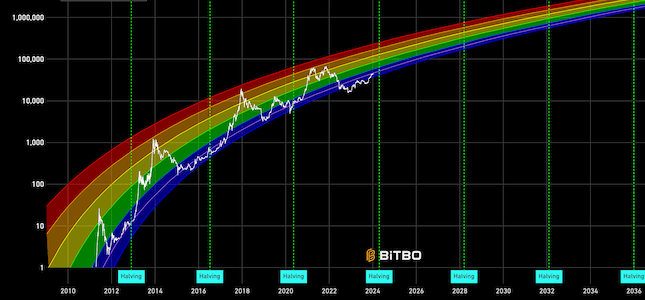
Original Rainbow Chart
The original Bitcoin rainbow price chart showing logarithmic regression bands.
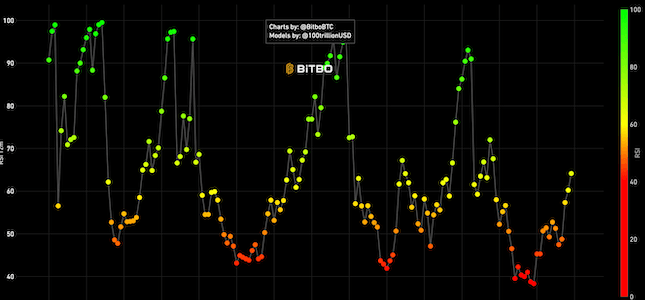
RSI
The Relative Strength Index (RSI) is a momentum based visualization.
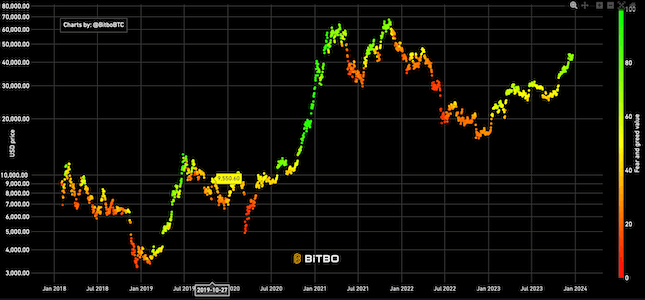
Bitcoin Fear and Greed Index
Sentiment analysis for Bitcoin & crypto markets, indicating when markets are overly fearful or greedy.
